All About the Moon
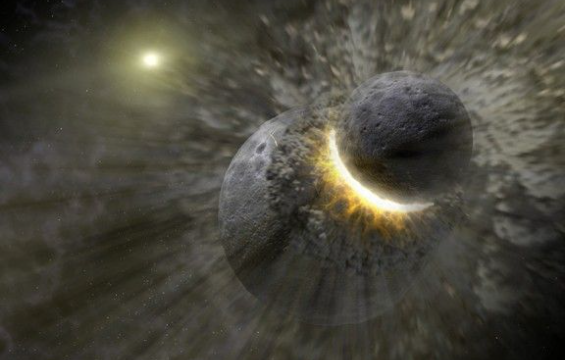
Why do we have a moon?
The Moon hasn’t always been here. Around 4.5 billion years ago, a Mars-sized object collided with the still-forming Earth. This impact scattered debris which then clumped together. By the time everything settled, this “clump” was one-quarter of the size of Earth, making our Moon one of the largest in the solar system.
Credit: NASA
Why does the Moon look like that?
It took time for the Moon to become what we see today. First, the debris came together, becoming a single solid sphere. As this cooled, a crust formed on the surface. Ancient volcanoes gushed magma which oozed into the Moon’s craters. Then, as the magma cooled, it formed smooth, flat areas in the shadow of the Moon’s hills and ridges.
These shaded plains are known as dark maria. Seen from Earth, they looked like seas to some observers, who gave them Latin names to match. They include Mare Tranquillitatis, or Sea of Tranquility (where humanity took its first steps on the Moon), and Mare Imbrium, the Sea of Showers, which has been explored by both crewed and remote missions.
When we look at the Moon today, it is polka-dotted with circles. These craters are giant dents created by billions of years of meteorite impacts. The size, speed and angle of a meteorite all affect what kind of mark it leaves on the Moon’s surface. The biggest craters, impact basins, can be hundreds of kilometers wide. Because there is no atmosphere on the Moon, we can still see some of the earliest craters formed on its surface (not to mention the tracks left by lunar landers and visiting astronauts).
![[Giordano Bruno Crater][Cratère Giordano Bruno]](/media/dohjw42b/moon-crater.jpg)
(Giordano Bruno Crater, Credit: NASA/GSFC/Arizona State University)
See how this works—try the Make an Impact activity at home!
Did you know?
Galileo Galilei is credited with making the first recorded observations of the Moon through a telescope. He noted that what was once thought to be a perfect sphere was in fact covered in mountains and craters.
What is the Moon made of?
Lunar soil is made up of fragments of the three kinds of rocks found on the Moon. Basalt, a kind of volcanic rock, fills the lunar maria, while the lunar highlands are mostly anorthosite, a white calcium-rich rock. The basalt in the maria is much younger than the anorthosite in the highlands, formed 3.8 billion years ago versus 4.5 billion. Finally, you’ll find breccia, rocks created when meteorites crash into the lunar surface, smashing, melting and mixing up the surface materials.
![[Near side of the moon and far side of the moon displayed side by side in one image.][La face visible de la Lune et la face cachée de la Lune sont affichées côte à côte sur une même image.]](/media/dlthame1/moon-nearside-farside.jpg)
Credit: NASA LRO / Jatan Mehta
The Moon in Culture
All around the world, humanity shares the experience of gazing at the Moon. As the brightest thing in the night sky, it’s no wonder this celestial body is significant in many cultures.
No matter where we are, when we look up on the same night, we see the same Moon at the same phase in its cycle. Because the Moon’s patterns are predictable, many cultures use lunar or lunisolar calendars to mark the passage of time. These include Islamic, Hindu and Chinese calendars. These calendars are based on the Moon’s phases as seen from Earth. It takes 29.5 days for the Moon to go through its eight phases, from new to full. (You can learn more about the Moon’s phases in our Moongazer’s Guide.)
The Moon has also inspired creativity in people around the world, including:
- Film and Television: Le Voyage dans la Lune; Wallace and Gromit’s “A Grand Day Out”; Space: 1999; Moonfall
- Music: Zoom, Zoom, Zoom, We’re Going to the Moon (children’s song); I Don’t Want to Live on the Moon (Sesame Street); Talking to the Moon (Bruno Mars); Fly Me to the Moon (Frank Sinatra)
- Books: The Adventures of Captain Underpants (Dav Pilkey); From Earth to the Moon (Jules Verne); Goodnight Moon (Margaret Wise Brown); The Moon is a Harsh Mistress (Robert A. Heinlein)
What’s your favourite story, song or art featuring the Moon?
Header image photo credits: NASA